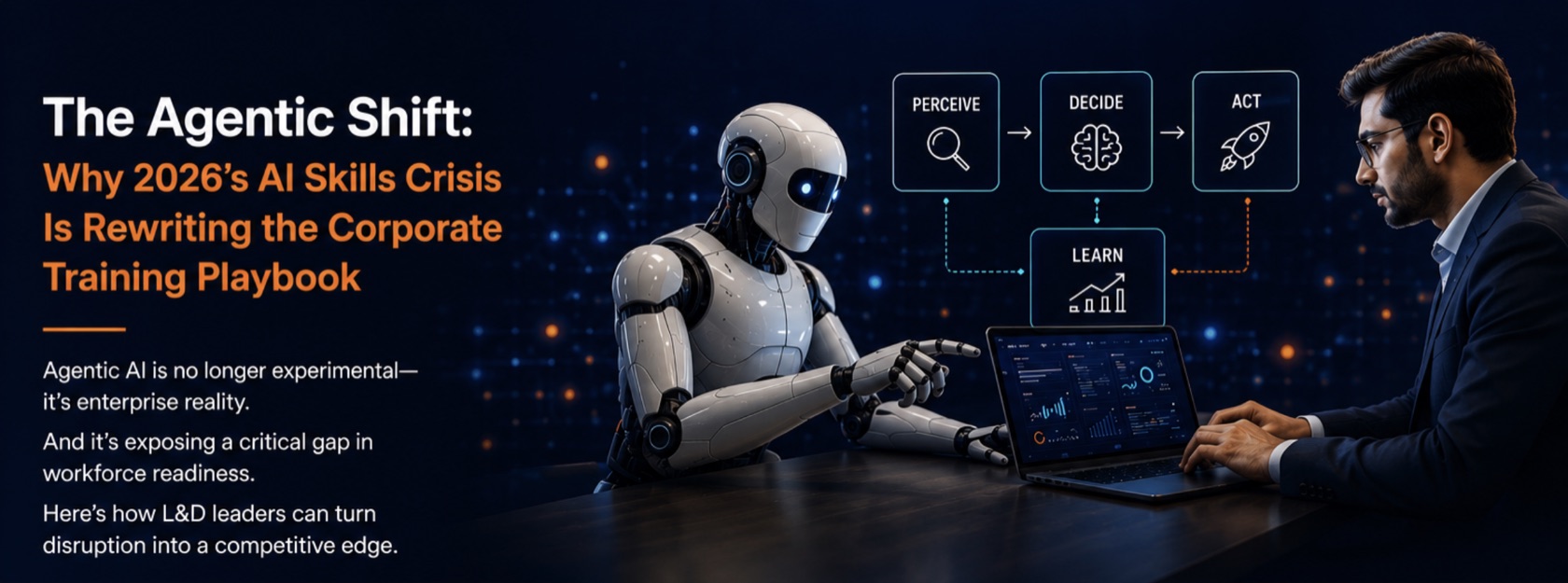
Something quietly decisive happened in enterprise technology this spring. The conversation stopped being about whether AI copilots could draft an email and became about whether autonomous AI agents could run a workflow end-to-end. As that shift moved from slide decks into production systems, it exposed a gap that no amount of software licensing can close: people who actually know how to design, supervise, and trust these systems are nowhere near as common as the systems themselves.
The data caught up fast. ManpowerGroup's 2026 Talent Shortage Survey found that AI skills have overtaken every other competency as the hardest for employers to find globally — not cloud, not cybersecurity, not data engineering. AI. And the imbalance is structural, not seasonal: analysts estimate that demand for AI talent now outstrips supply by roughly 3.2 to 1, with well over a million open AI-related roles chasing a fraction of that in qualified candidates.
For learning and development leaders, this is the moment the ground genuinely moves. You cannot recruit your way out of a 3-to-1 shortage. The only lever large enough to matter is building the capability inside the organization you already have — and building it continuously, because the half-life of an "AI skill" is now measured in months, not years.
Why the old training model breaks under this load
The corporate training market is enormous and growing — roughly $444.9 billion in 2025, on track toward $808.9 billion by 2033. But scale has hidden a structural flaw. Most of that spend still flows through a program-based model: identify a need, build or buy a course, run a cohort, issue a certificate, move on. That model assumes the skill you're teaching will still be the skill you need a year later.
Agentic AI breaks that assumption completely. The tools change quarterly. The right way to prompt, orchestrate, and govern them changes with each model release. By the time a traditional curriculum is built, reviewed, and rolled out, a meaningful slice of it is already stale. It's no surprise that 74% of companies say they aren't keeping up with their own demand for new skills, and fewer than 40% report having a clear reskilling strategy at all.
"Upskilling only works when it's continuous and embedded in the work itself — not bolted on as an event that ends when the certificate prints."
The industry's leading analysts have been blunt about the direction. Josh Bersin's early-2026 research on how AI is reshaping the $400-billion corporate learning market describes a market "transforming around AI" — moving from static content libraries toward systems that generate, personalize, and orchestrate learning in real time. The destination is clear; most organizations simply haven't redesigned their L&D function to reach it.
The new playbook: four shifts that actually matter
Across the most credible 2026 research — Bersin, the WEF Future of Jobs work, the TalentLMS State of L&D report, and the major consultancies' enterprise-AI studies — the same four shifts keep surfacing. Treat these as the spine of a modern enterprise learning strategy.
1. From roles to skills
Skills, not job titles, are becoming the unit of workforce planning. A skills-based approach starts by mapping the specific capabilities a business priority demands, identifies each person's gap against that map, and routes targeted learning to close it. This is the foundation everything else sits on — without a connected skills architecture, "AI upskilling" is just buying seats and hoping.
2. From events to continuous, embedded learning
The most durable capability is built in the flow of work: short, contextual learning moments tied to real tasks, reinforced over time. AI makes this practical for the first time — micro-lessons, just-in-time guidance, and practice scenarios can be surfaced inside the tools employees already use, rather than pulling them into a separate LMS once a quarter.
3. From content delivery to AI orchestration
The frontier use cases are no longer "AI that recommends a video." They're AI-driven needs analysis, AI-generated skills models, conversational tutors and coaches, and personal learning agents that know an employee's role, level, and history and adapt accordingly. The L&D team's job shifts from producing content to curating, governing, and orchestrating these systems.
4. From completion rates to business outcomes
Course completions tell you almost nothing. The 2026 standard ties learning directly to business KPIs: readiness indicators, measurable performance improvement, internal mobility rates, and predictive risk signals about where capability gaps will bite next.
The most common 2026 mistake is treating AI fluency as an engineering-only concern. The shortage research is clear that the deepening gaps are also in judgment, strategic thinking, and adaptability — the human capabilities required to supervise agentic systems well. An AI-ready workforce needs technologists who can build and a much broader population who can collaborate with, question, and govern what the technologists build.
What this means for AI fluency across the whole organization
As enterprises move from chatbots and copilots to agentic applications, AI literacy stops being a specialist skill and becomes a baseline one — closer to spreadsheet literacy in the 1990s than to a niche certification. The practical implication: training has to be tiered, not uniform.
- Foundational fluency for everyone — how these tools work, where they fail, how to prompt and verify, and the governance and data-handling rules that keep the organization safe.
- Applied capability for practitioners — role-specific use of agents and copilots in finance, marketing, operations, support, and HR, taught against that team's real workflows.
- Deep technical depth for builders — agent design, orchestration, evaluation, and the data and cloud foundations underneath, for the engineers and data teams shipping these systems.
This is precisely where a practitioner-led model earns its keep. Capability that has to stay current with quarterly tool changes is learned far faster from people who use these systems in production than from a static, pre-recorded library — and it has to be tailored to the team's actual stack and objectives, not delivered as a generic overview.
A 90-day starting point for L&D leaders
You don't have to rebuild everything at once. A focused first quarter creates momentum and the evidence base to justify the larger shift:
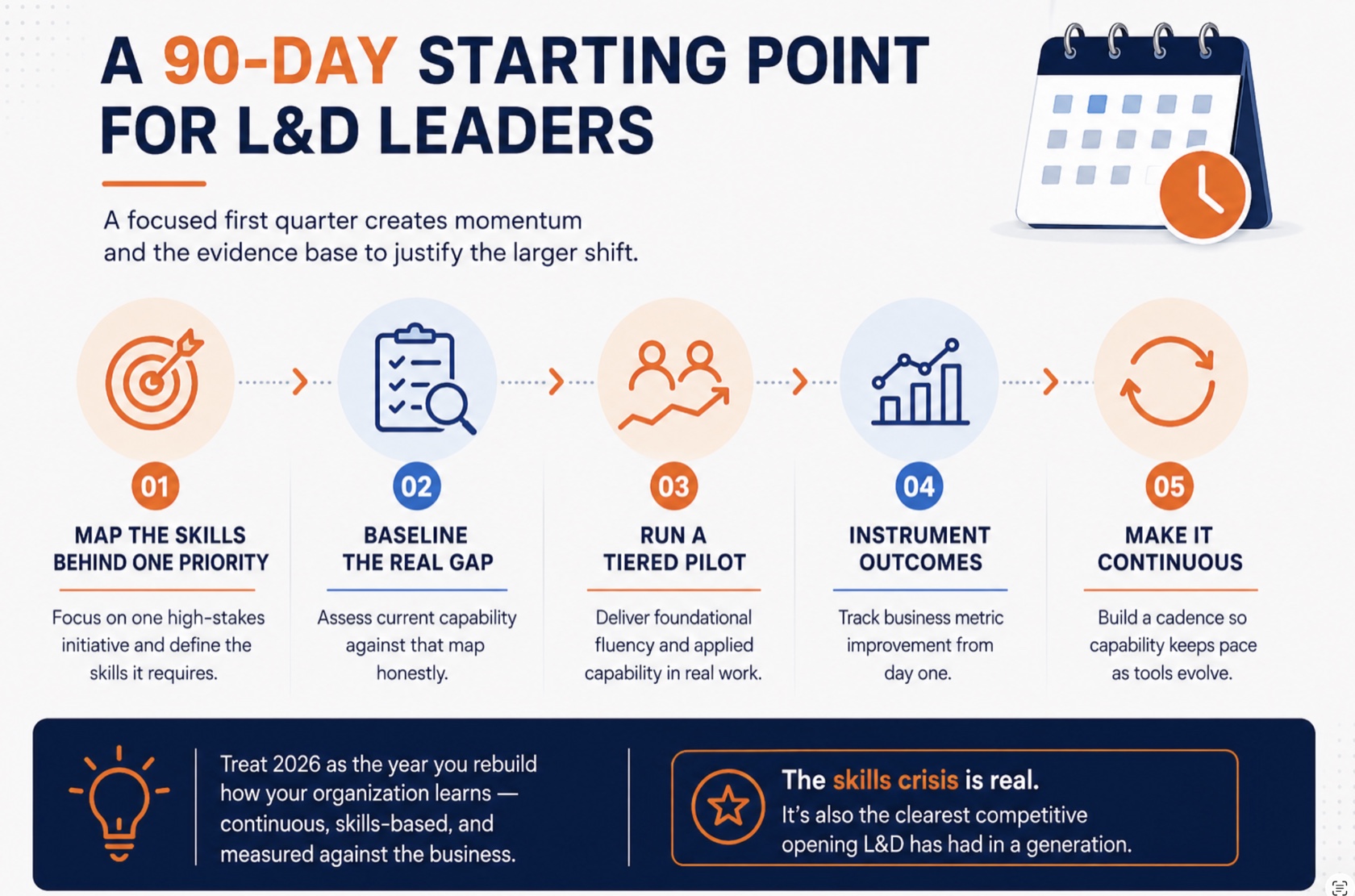
The enterprises that treat 2026 as the year they rebuilt how they learn — continuous, skills-based, AI-orchestrated, and measured against the business — will compound an advantage that the ones still buying courses simply can't catch. The skills crisis is real. It's also the clearest competitive opening L&D has had in a generation.
Sources & further reading
- ManpowerGroup, 2026 Talent Shortage Survey — AI skills ranked hardest to find globally.
- Josh Bersin, The Enterprise Learning Tech Market Quickly Transforms Around AI (Feb 2026).
- World Economic Forum, Future of Jobs — 59% of the workforce needing reskilling by 2030.
- TalentLMS, The 2026 L&D Report: The State of Workplace Learning.
- Gloat, AI Workforce Trends 2026; Deloitte, State of AI in the Enterprise 2026.